Is Click-to-Cancel the Law Yet? What It Means for Your Security Camera Subscription in 2026
This article was produced with AI assistance. Sources are listed at the end.
No — there still isn't a federal law guaranteeing you can cancel a subscription in one click. The FTC's "Click-to-Cancel" rule was struck down by a federal appeals court in 2025, and as of October 2026 the agency is still rewriting it from scratch. If your security camera's cloud storage or AI-detection plan auto-renews, your right to a quick, no-hassle cancellation currently depends on which state you live in, not on any single federal rule.
Why isn't there a federal click-to-cancel rule in 2026?
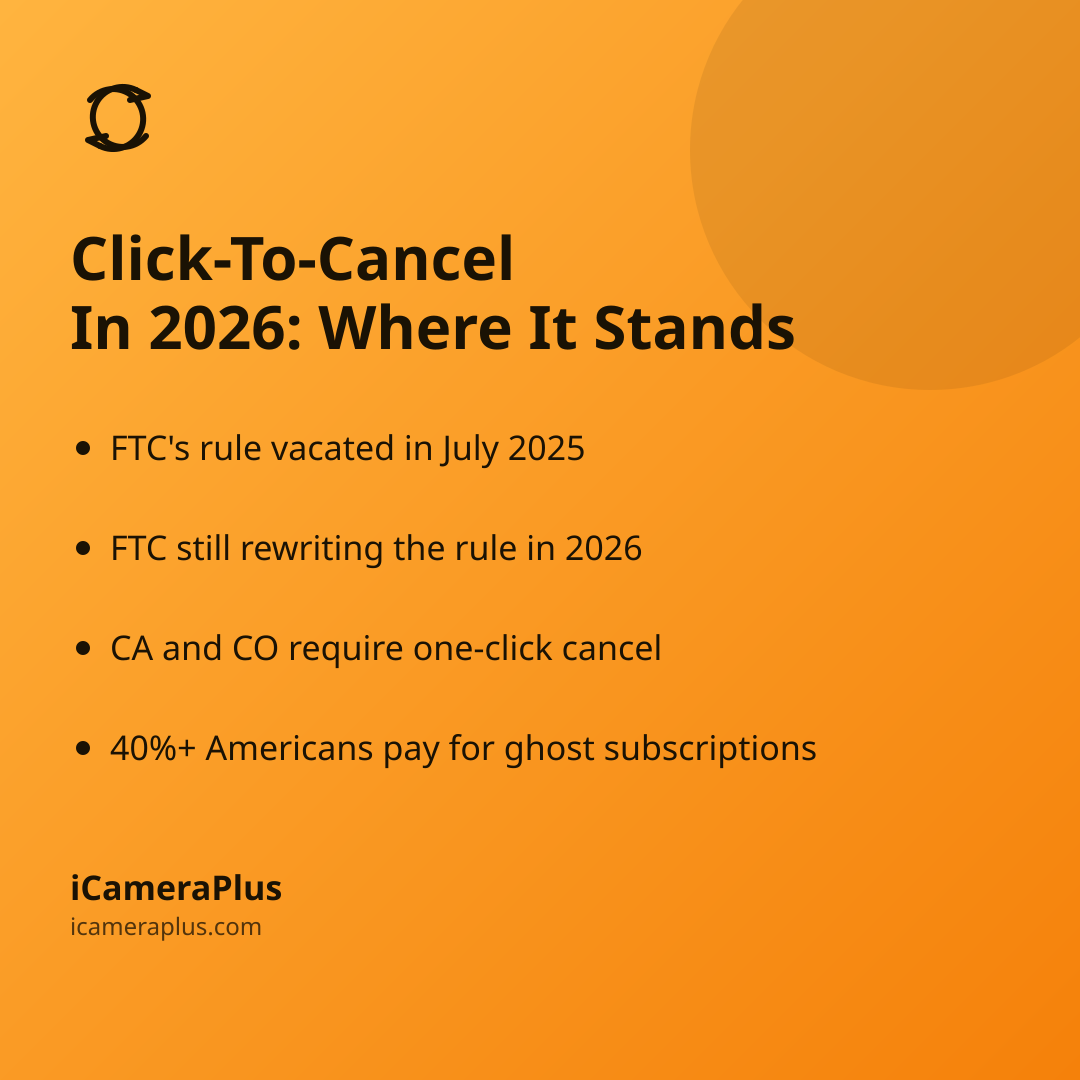
There was one, briefly. The Federal Trade Commission finalized an update to its Negative Option Rule — widely nicknamed "Click-to-Cancel" — requiring that canceling a subscription be as easy as signing up for one. It was set to take effect on July 14, 2025. Six days before that, on July 8, 2025, the U.S. Court of Appeals for the Eighth Circuit vacated the rule entirely, ruling that the FTC had violated the Administrative Procedure Act by skipping a required cost-benefit analysis for a rule with over $100 million in projected economic impact, according to a client alert from law firm WilmerHale.
Is the FTC trying again?
Yes. The FTC submitted a draft Advance Notice of Proposed Rulemaking on the Negative Option Rule to federal regulators on January 30, 2026, according to the agency's own press release. That notice was published in the Federal Register on March 13, 2026, opening a public comment period that closed April 13, 2026, per the official Federal Register filing. As of this writing, no new final rule has been issued — the rulemaking process is still in progress.
Which states already require one-click cancellation?
Several states moved ahead on their own while the federal rule was tied up in court. California's AB 2863 amended the state's Automatic Renewal Law effective July 1, 2025, requiring businesses to post a prominent "click to cancel" option and let consumers cancel through the same method they used to sign up, according to a summary from the National Law Review. Colorado's Online Cancellation Act (SB25-145) required a one-click cancellation link for online subscriptions starting August 6, 2025, and was expanded on February 16, 2026 to also cover business-to-business subscriptions, per legal analysis from the Business Law Group. If you live outside those states, your cancellation experience still depends on the company's own policy.
How much are forgotten subscriptions actually costing you?
More than 40% of Americans are paying for a "ghost" subscription they forgot they ever signed up for.
That figure traces back to a 2022 C+R Research survey, in which 42% of respondents admitted they'd kept paying for a subscription after they'd stopped using it, and 72% said they set all of their subscriptions to auto-pay. The number is still the benchmark cited in 2026 coverage, including CNBC Select's roundup of subscription trackers, which puts the average forgotten subscription at about $17 a month, or more than $200 a year. Security camera cloud plans fall into exactly this category: recurring charges that renew automatically unless you actively go cancel them, something we've tracked as camera-related costs keep climbing in 2026.
What does this mean for the camera watching your home?
If you're shopping for a new camera, the subscription question is worth asking before you buy, not after: how do you cancel, and does the seller make that process easy or deliberately annoying? One way to sidestep a chunk of this entirely is to not buy new hardware at all. Turning a phone you already own into a security camera — which is exactly what iCameraPlus lets you do, with continuous recording, a private cloud archive you can browse from the web, and remote start/stop on iOS and Android — means you're not locked into a new device's ecosystem just to get footage off of it. We've made that same case when comparing a discounted sale camera to the phone already in your drawer.
That said, any ongoing cloud storage plan — iCameraPlus's included — is still a recurring charge, and it's still worth reading the cancellation terms before you subscribe, especially since federal protections are mid-rewrite. A few habits make this painless regardless of which law applies where you live:
- Check your state's cancellation law
- Cancel the same way you signed up
- Screenshot the cancellation confirmation
- Review auto-renew terms once a year
Quick answers
Is click-to-cancel a federal law right now? No. The FTC's version was vacated by a federal appeals court in July 2025, and the agency's replacement rulemaking was still in progress as of October 2026, with no new rule finalized.
Does any click-to-cancel law apply specifically to security cameras? No — there's no camera-specific statute. Camera cloud storage and AI-detection subscriptions are covered by the same general automatic-renewal and negative-option laws that apply to any recurring charge, so protection depends on your state, not your device.
What can I do if a company won't let me cancel online? Document your attempt, check whether your state (such as California or Colorado) has its own one-click cancellation law, and if you're stuck, you can dispute the charge with your card issuer or file a complaint with your state attorney general or the FTC.

Sources
- WilmerHale: Eighth Circuit Vacates the FTC's "Click to Cancel" Rule (2025)
- FTC: FTC Submits Draft ANPRM Related to Negative Option Plans to OMB for Review (2026)
- Federal Register: Rule Concerning the Use of Prenotification Negative Option Plans (2026)
- National Law Review: FTC "Click to Cancel" Rule and California's Updated Automatic Renewal Law
- Business Law Group: Colorado's New "Click to Cancel" Rule
- C+R Research: Subscription Service Statistics and Costs (2022)
- CNBC Select: Best Subscription Trackers of 2026 (citing C+R Research)