Is Summer Really Burglary Season? What New FBI Data Says About When Break-Ins Actually Spike

Every July, the same warning resurfaces in insurance newsletters and local news segments: summer is prime time for burglars, because homeowners are traveling and houses sit empty. It's repeated so often it feels like settled fact. A new analysis of FBI crime data, published this month, tells a more complicated story — and if you live on the Pacific Coast, it may be close to the opposite of true.
What the Newest Data Actually Shows
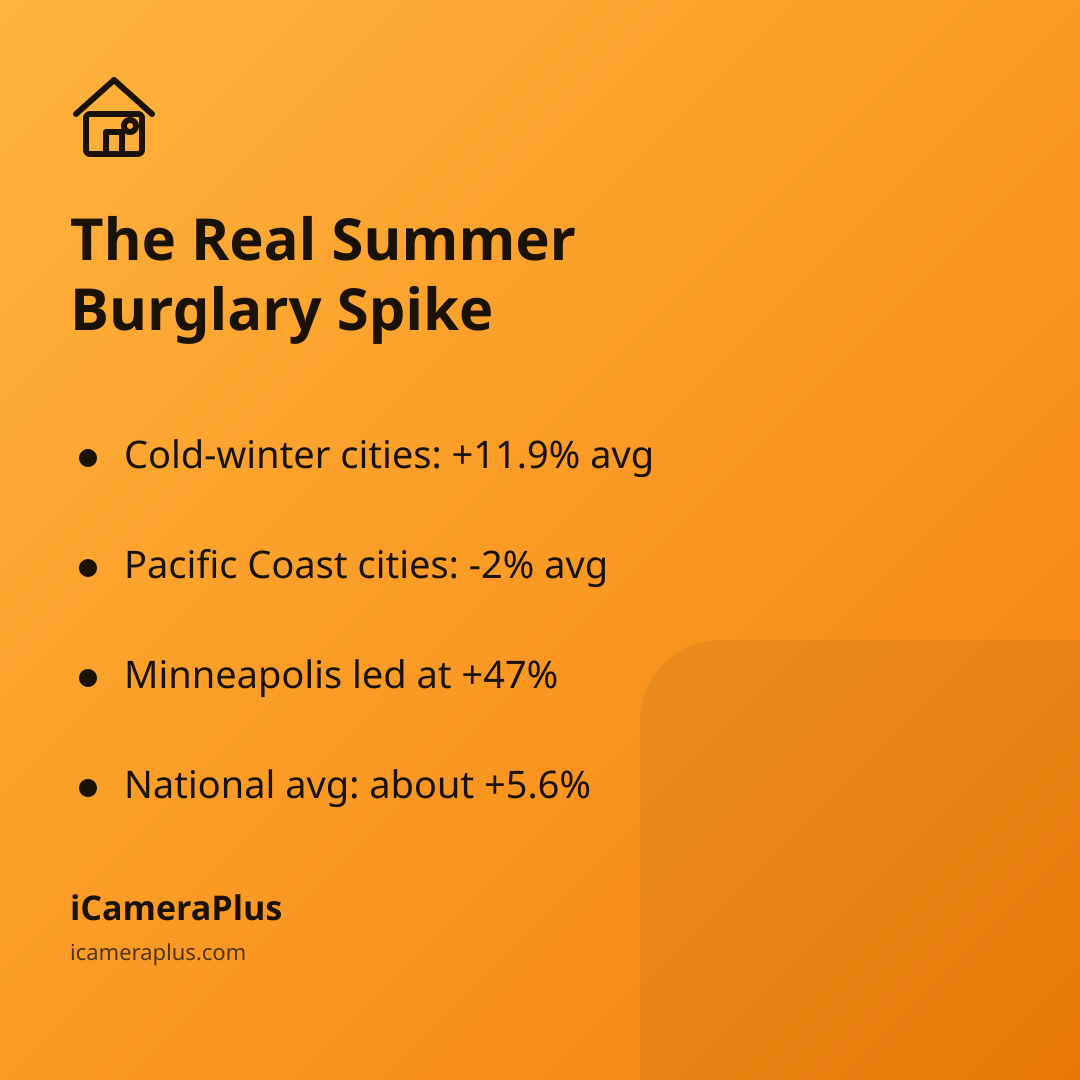
On July 14, 2026, MoneyGeek published an analysis of FBI National Incident-Based Reporting System (NIBRS) data pulled from the Crime Data Explorer, covering 74 of the largest U.S. cities from 2022 through 2024. The headline finding: nationally, burglaries in the summer months run only about 5.6% higher than the rest of the year — a far cry from the 20%-plus seasonal surge often repeated in older insurance-industry materials. The median city saw just a 5.5% summer lift.
That national average, though, hides enormous regional variation, and the details matter more than the headline.
The Pattern Is Regional, Not National
Splitting the 74 cities by climate, the same July 2026 analysis found three distinct patterns:
- Cold-winter cities (35 metros): a real summer effect, averaging an 11.9% increase in burglaries. Minneapolis led the country at +47%, followed by St. Paul (+25.8%), Newark (+25%) and Buffalo (+20.5%).
- Sun Belt cities (25 metros): a modest 4.8% average lift, with "no strong seasonal signal in either direction," according to the report.
- Pacific Coast cities (14 metros): burglary rates actually dropped in summer, averaging -2%. Riverside (-12.3%), Portland (-10.2%) and San Diego (-9.5%) posted the lowest summer rates in the country.
In head-to-head comparisons across the dataset, cold-winter cities out-paced Pacific Coast cities in summer burglary lift in 87% of matchups (425 of 490). The likely explanation, per the analysis: harsh winters naturally suppress break-ins by keeping people and porch traffic indoors, so the "thaw" into summer travel and open windows creates a sharper contrast in places where winter really is a lockdown season — while cities with mild year-round weather never get that seasonal dip to bounce back from.
Why the Old Rule of Thumb Stuck Around
The "summer is burglary season" line has circulated in consumer-safety materials for a long time, and it isn't baseless — it's just imprecise. It was built for a national average that, as the new city-by-city data shows, was always an uneven blend of a sharp Midwest/Northeast effect and a flat-to-negative West Coast effect. If you've only ever heard the national version, it's worth checking how your own metro area actually behaves using the FBI's public Crime Data Explorer rather than assuming the summer-spike story applies to you.
The Bigger Picture: Burglary Is Rarer Than It Feels
Zooming out, break-ins are a smaller slice of homeowner risk than the summer headlines suggest. According to the Insurance Information Institute's (III) 2023 data (the latest available, sourced from ISO), 5.3% of insured homes filed a property claim of any kind that year, and theft-related property claims affected roughly 1 in 850 insured homes — about 0.6% of all homeowners claims. That's genuinely good news. It also means that when a break-in does happen, most households aren't practiced at handling it, which is exactly when good documentation pays off.
Preparation Beats Guessing the Calendar
Since where you live — not the month on the calendar — is the bigger variable, the more useful question is: are you ready either way? The III recommends creating a home inventory and specifically suggests "walking through your house or apartment videotaping and describing the contents" — noting makes, models and purchase details — so a claim after a theft or fire can be settled quickly and accurately.
A once-a-year inventory video is useful, but it only captures a single moment. A camera that records continuously does something a walkthrough video can't: it captures the actual entry, not just what was taken afterward. This is a case where repurposing a phone you already own makes practical sense — mounted to face a door, driveway or main living area, it can provide the same kind of evidence the III recommends, but running around the clock instead of once a year. Apps like iCameraPlus are built for exactly this: they turn an old phone into a continuously recording camera that archives footage off the device itself, so the recording still exists even if the phone is damaged or taken during a break-in.
Will a Camera Actually Lower Your Insurance Bill?
It's worth being honest about this, because it's oversold in a lot of security marketing. Insurers do offer discounts for "protective devices," and Progressive's own consumer guidance confirms that "many insurers will offer discounts for video surveillance cameras and home security systems" — but adds plainly that "the amount of your discount, if any, varies by insurer." The III's guidance on saving money on homeowners insurance echoes this: check with your provider before you install anything, because not every system qualifies, and centrally monitored systems typically unlock bigger discounts than self-monitored setups.
In practice, that means a repurposed phone camera should be treated as a documentation and awareness tool first, and a possible insurance discount second — call your insurer and ask what they credit, rather than assuming.
A Low-Cost Way to Start
Most households already own the hardware for this. The EPA notes that Americans collectively own more than 3 billion electronic products, averaging 24 devices per household — a large share of which are old phones sitting in a drawer instead of doing anything useful. Before that phone heads to a recycling bin or a junk drawer for good, pointing it at your front door or driveway costs nothing but a mount and a charging cable, and turns idle e-waste into an active layer of home security camera coverage.
The Bottom Line
The calendar isn't your risk profile — your zip code, your travel habits, and how prepared you are matter more. If you live in a cold-winter city, summer genuinely is a higher-risk stretch worth taking seriously. If you're on the Pacific Coast, the data says the opposite. Either way, the households that come out ahead after an incident are the ones with footage and documentation already in place, not the ones who were just watching the calendar.

Sources
- MoneyGeek — "Summer Burglary by Region: Where the Pattern Reverses" (FBI NIBRS data via Crime Data Explorer, 2022-2024; published July 14, 2026)
- FBI — National Incident-Based Reporting System (NIBRS)
- Insurance Information Institute — Facts + Statistics: Homeowners and Renters Insurance (2023 data)
- Insurance Information Institute — How to Create a Home Inventory
- Insurance Information Institute — How to Save Money on Your Homeowners Insurance
- Progressive — Will a Security System Lower My Insurance?
- U.S. EPA — Helping Communities Manage Electronic Waste