Is Your Security Camera Linked to China? What the Lorex and Resideo Lawsuits Reveal in 2026
Since September 2025, attorneys general in Nebraska and Texas, plus a federal class action filed in January 2026, have brought four separate lawsuits against security-camera makers Lorex and Resideo. The lawsuits allege both companies marketed cameras as "private by design" while depending on hardware, firmware, or cloud infrastructure from Dahua and Hikvision, two Chinese manufacturers the U.S. government has restricted since 2019 over national-security and human-rights concerns. None of the cases claim a specific homeowner's footage was intercepted by Beijing; they allege the companies concealed a known risk from buyers who assumed they were getting a fully private device. One of the four cases has already resolved — Resideo settled with Nebraska in August 2026 — while the Lorex cases in Nebraska, Texas, and federal court remain open.
If you own a camera from either brand, or you're shopping for one, here's what the lawsuits actually say, what they don't say, and how to check your own equipment.
What are Lorex and Resideo accused of?
Nebraska Attorney General Mike Hilgers sued Lorex on September 23, 2025, alleging the company sold cameras — including ones marketed for nurseries and children's bedrooms — that "put Nebraskans' security at risk" by relying on Dahua-sourced components despite advertising the products as private and secure. The complaint states that Lorex continued sourcing from Dahua even after Dahua sold Lorex to a Taiwan-based holding company in 2022, and that Dahua remains legally obligated under Chinese law to assist state intelligence requests.
Three months later, on December 22, 2025, Hilgers filed a second suit, this time against Resideo Technologies and its ADI Global Distribution business, alleging it sold surveillance cameras manufactured by Hikvision and Dahua without disclosing their "national-security and cybersecurity risks." On February 18, 2026, Texas Attorney General Ken Paxton filed a similar suit against Lorex, seeking damages of up to $10,000 per violation under the Texas Deceptive Trade Practices Act. A separate federal class action against Lorex was filed January 16, 2026 in the Eastern District of New York (case 2:26-cv-00293), making similar claims on behalf of consumer buyers rather than a state.
Why does a Dahua or Hikvision component actually matter?
This isn't a new concern — it's a years-old federal finding that these lawsuits say companies kept selling around. In October 2019, the U.S. Department of Commerce's Bureau of Industry and Security added Dahua and Hikvision to its Entity List over their role in surveillance abuses documented in the Commerce Department's Federal Register notice. Hikvision and Dahua were then added to the FCC's Covered List of communications equipment posing national-security risk in March 2021. In November 2022, the FCC adopted rules under the Secure Equipment Act of 2021 banning new equipment authorizations for any product from a company on that list — a ban that took effect in February 2023 and covers Hikvision's and Dahua's video-surveillance equipment.
State attorneys general and consumers have sued camera makers four times in five months over the same supplier.
The lawsuits argue that buyers had no way to know a "private by design" camera on a Costco or Best Buy shelf might still route through restricted hardware, firmware, or network infrastructure — precisely the disclosure gap the Entity List and Covered List were meant to make visible to institutional buyers, but which rarely reaches a household shopper reading a product box.
Does this affect the camera you already own right now?
Not automatically, and the two companies' cases are now in different places. Resideo and its ADI Global Distribution business settled the Nebraska case in August 2026: a Lancaster County judge approved a consent judgment in which the companies agreed to stop selling Dahua- and Hikvision-made products in Nebraska, pay $400,000, and fund refunds for Nebraska buyers of the affected products from the past four years — without admitting liability. The Lorex cases in Nebraska, Texas, and federal court are still open; no product recall has been issued, and courts have not ruled on the merits or found Lorex liable. Owning or using a Lorex or Resideo/ADI camera is not illegal either way — the claims are about deceptive marketing and undisclosed risk, not proof that any individual household's footage was accessed. Still, if privacy is the reason you bought a camera in the first place, it's worth knowing what to check.
How can you check your own camera?
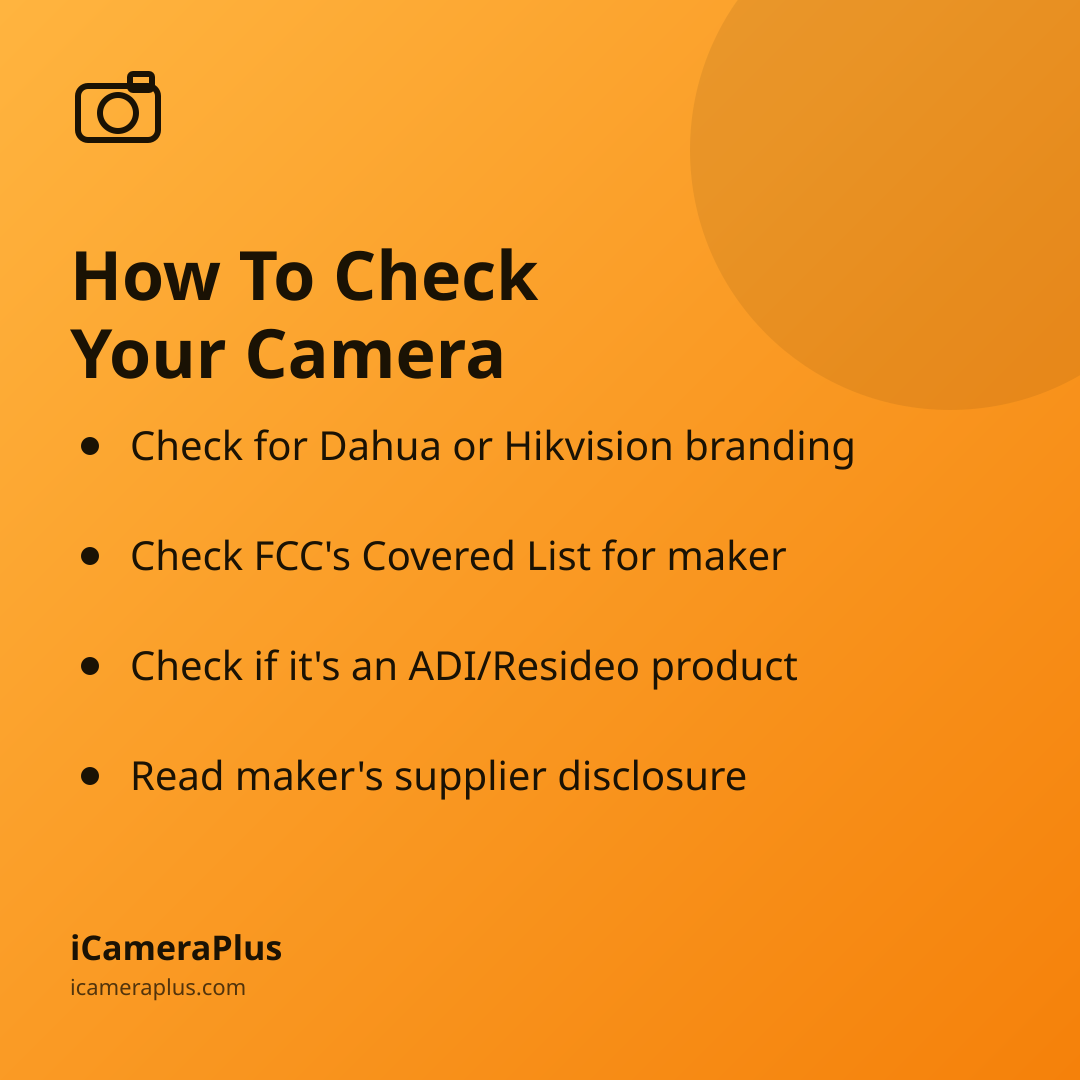
- Check for Dahua or Hikvision branding
- Look up the manufacturer on the FCC's Covered List
- Check if it's an ADI/Resideo product
- Read the manufacturer's supplier disclosure, if any
Start by looking at the box, manual, or manufacturer app for any mention of Dahua, Hikvision, or ADI Global Distribution. The FCC's Covered List names companies and equipment categories, not individual model numbers, so matching the manufacturer name is more useful than trying to search a device's FCC ID against it. Hikvision and Dahua have been on that list since March 2021, and new equipment authorizations for their video-surveillance products have been banned since February 2023 — but that ban only stops new authorizations, not existing sales, so an older device with a Dahua or Hikvision component won't show up as newly blocked just because it predates the ban.
What can you do instead of buying another unfamiliar camera?
One straightforward way to sidestep the supplier question entirely is to use hardware whose origin you already know: a phone you already own. An app like iCameraPlus turns an old phone into a continuously recording security camera, with footage archived off-device and available for remote live view and motion alerts — without introducing a new device, a new manufacturer, or an unfamiliar supply chain into your home. It won't replace every feature of a purpose-built camera system, but for watching a front door, a nursery, or a room you already trust, it removes the exact question these lawsuits are about: who actually built the hardware, and what does it depend on?
The same logic applies if you're specifically looking at baby monitor or nursery camera options, since several of the disputed products were marketed for that use.
Quick answers
Is it illegal to own a Lorex or Hikvision camera?
No. Private ownership and use of these cameras is not illegal in the U.S. The FCC's rule, adopted in 2022 and effective February 2023, blocks new equipment authorizations for sale, and some federal, state, and critical-infrastructure buyers face procurement restrictions, but a homeowner who already owns one isn't breaking any law by using it.
Have Lorex or Resideo recalled any cameras over these claims?
No formal product recall has been issued. Resideo settled its Nebraska case in August 2026, paying $400,000 and agreeing to stop selling Dahua- and Hikvision-made products in the state, without admitting liability. The Lorex lawsuits in Nebraska, Texas, and the Eastern District of New York remain open as of September 2026.
Does using an old phone as a camera avoid this issue?
Largely, yes. The lawsuits center on undisclosed components inside purpose-built camera hardware. A phone you already own and previously used for years doesn't introduce a new, unfamiliar supplier into your home the way buying a new camera does.
Sources
- Nebraska Attorney General: Hilgers Sues Lorex (September 23, 2025)
- Nebraska Attorney General: Hilgers Sues Resideo (December 22, 2025)
- Nebraska Attorney General: Hilgers Secures Settlement with Resideo and ADI (August 2026)
- ClassAction.org: Lorex Federal Class Action Filing Summary
- Texas Attorney General: Paxton Sues Lorex (February 18, 2026)
- U.S. Federal Register: Addition of Certain Entities to the Entity List (2019)
- Federal Communications Commission: Covered List