National Night Out 2026: What a Home Camera Registry Actually Shares With Police (and What It Doesn't)
On Tuesday, August 4, 2026, thousands of neighborhoods across the country will hold block parties, cookouts, and police meet-and-greets for National Night Out, the annual community-safety campaign coordinated by the National Association of Town Watch. It's a low-key event — folding tables, sparklers, a patrol car kids can climb into — but it's also the week many local police departments use to promote something quieter and more useful: a voluntary home camera registry.
If you've never heard of one, the name makes it sound bigger than it is. It is not a live surveillance network, and it does not give officers a feed into your home. Here's what it actually does, why it exists, and how to make sure the camera you register is one that actually has something worth showing them.
What a Camera Registry Program Actually Is
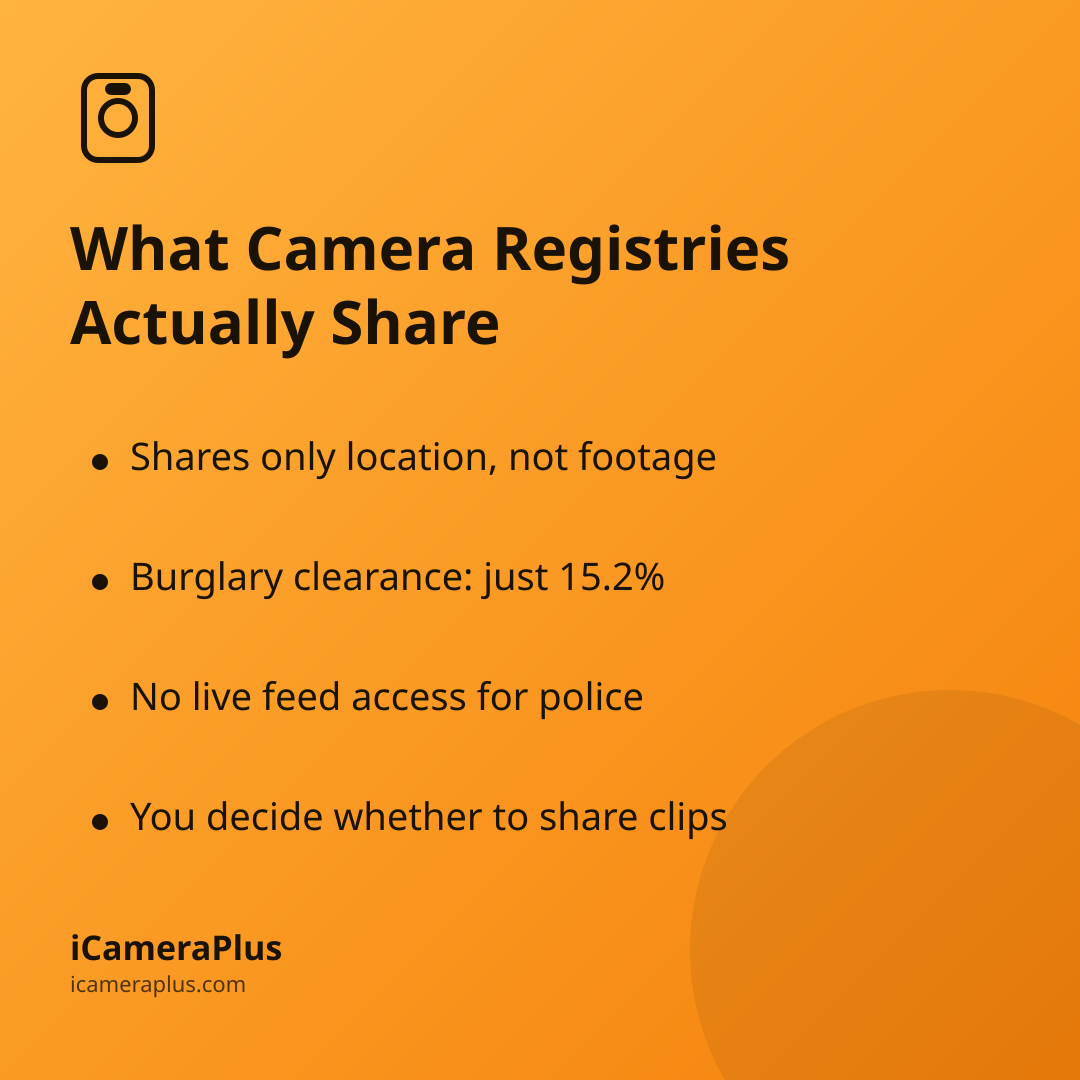
Dozens of U.S. police departments — from Raleigh, North Carolina to Davenport, Iowa — run some version of the same idea: an opt-in directory where residents and business owners list the location of their outdoor cameras. That's it. Raleigh's own registration terms are explicit that signing up "does not grant direct access to your camera." Investigators only see that a camera exists near a location and how to contact its owner — not what it recorded.
When a crime happens nearby, an officer can check the map instead of knocking on twenty doors hoping someone has footage. If your camera catches something relevant, you decide whether to hand it over. Nothing is pulled automatically, and nothing is watched in real time.
Sergeant Ann Sievert of the Davenport Police Department put it plainly to a local news station in February 2026: "Surveillance footage can make or break an investigation. We use surveillance footage in almost everything, from package thefts and harassment cases all the way to homicides, robberies and kidnappings." Her point wasn't about access — it was about how often footage fills in the gaps around an incident, even when the crime itself happens just out of frame.
Why It Matters: Most Break-Ins Are Never Solved
It's worth being honest about why investigators lean on this so heavily. According to the FBI's Uniform Crime Reporting Program's 2024 data, burglary had a clearance rate of just 15.2 percent — meaning roughly 85 out of every 100 reported burglaries closed in 2024 without an arrest. Physical evidence at a break-in is often thin: no fingerprints, no witnesses, no consistent forensic trail. Video is frequently the only record that a specific person was on a specific property at a specific time.
That's also why registries emphasize location over content. A camera that only exists on paper, or one that stopped working months ago, doesn't help anyone. The value of the program rises and falls with whether the cameras on the map are actually recording.
The Part Registries Don't Solve: Having Usable Footage
This is where a lot of home setups quietly fail. A camera that only saves motion clips to a cramped local memory card, or one on a monthly cloud plan that overwrites itself after a week or two, may have nothing left by the time anyone asks for it — including you. If you're going to take the ten minutes to register a camera, it's worth spending five more making sure it will actually have something to offer if you're ever asked.
You also don't need to buy a dedicated camera to be a useful registrant. A phone you've already retired to a drawer — turned outward at a driveway, porch, or side gate — works the same way a mounted security camera does, minus the new purchase. Apps like iCameraPlus turn that old phone into a continuous-recording camera with an off-device archive, remote live view, and motion alerts, so footage from weeks ago is still there if you need it, not just the last few hours. It's your device, your account, and your footage — you're the only one who decides whether to share a clip with anyone, registry or not.
What These Programs Deliberately Don't Do
A few things worth knowing before you sign up, so you're registering with clear expectations:
- No live access. Registries share contact information, not a video stream. Police can't watch your camera in real time simply because you're on a list.
- No automatic handover. Even after a nearby crime, officers still have to ask, and you still have to agree — or they need a warrant, the same as with any other private recording.
- No cost, no hardware requirement. Every program cited here is free and open to whatever camera you already have, phone-based or otherwise.
- No obligation to keep participating. Most departments let you update or remove your registration whenever your setup changes.
That "ask first" structure is the same standard worth holding your own camera to generally: it's there to document your own property, transparently, on terms you control — not to monitor anyone without their knowledge. If you're mounting a camera that can see a shared driveway, a neighbor's entrance, or public sidewalk, it's worth reviewing what you can and can't lawfully capture before National Night Out conversations turn into "hey, can I see your camera."
A Short Checklist Before August 4
- Walk your property and confirm every camera you own is actually recording — not just plugged in and blinking.
- Check how far back your storage actually goes. A few hours or days is often not enough; aim for continuous recording with an off-device archive.
- If you have an old phone doing nothing in a drawer, consider mounting it as an additional angle — a second exterior view is often what fills in a timeline gap.
- Search "[your city] camera registry" or ask at your local National Night Out event whether your department runs one.
- Register only the camera's approximate location and your contact preference — you're not required to share anything else.
None of this requires new equipment, a subscription commitment, or giving up control of your footage. It just means that if something does happen on your block, the camera you already have is actually ready to help — starting with you.