Your Camera Company Shut Down: What the Belkin Wemo Wake-Up Call Means for Your Home Security
On January 31, 2026, a lot of smart homes got a little dumber. As 9to5Google reported, Belkin pulled the plug on cloud services and app support for a wide swath of its Wemo product line — smart plugs, switches, bulbs, sensors, a video doorbell, and baby monitors among them. Remote access and voice assistant integrations stopped working for anyone who hadn't already switched their devices over to a local platform like Apple HomeKit. Belkin's own explanation, from its official support notice: "we must focus our resources on different parts of the Belkin business."
If you weren't a Wemo customer, it's tempting to shrug this off as someone else's bad luck. But if any part of your home security setup depends on a manufacturer's cloud servers staying online — and most do — the Wemo shutdown is worth five minutes of your attention.
This Wasn't a One-Off
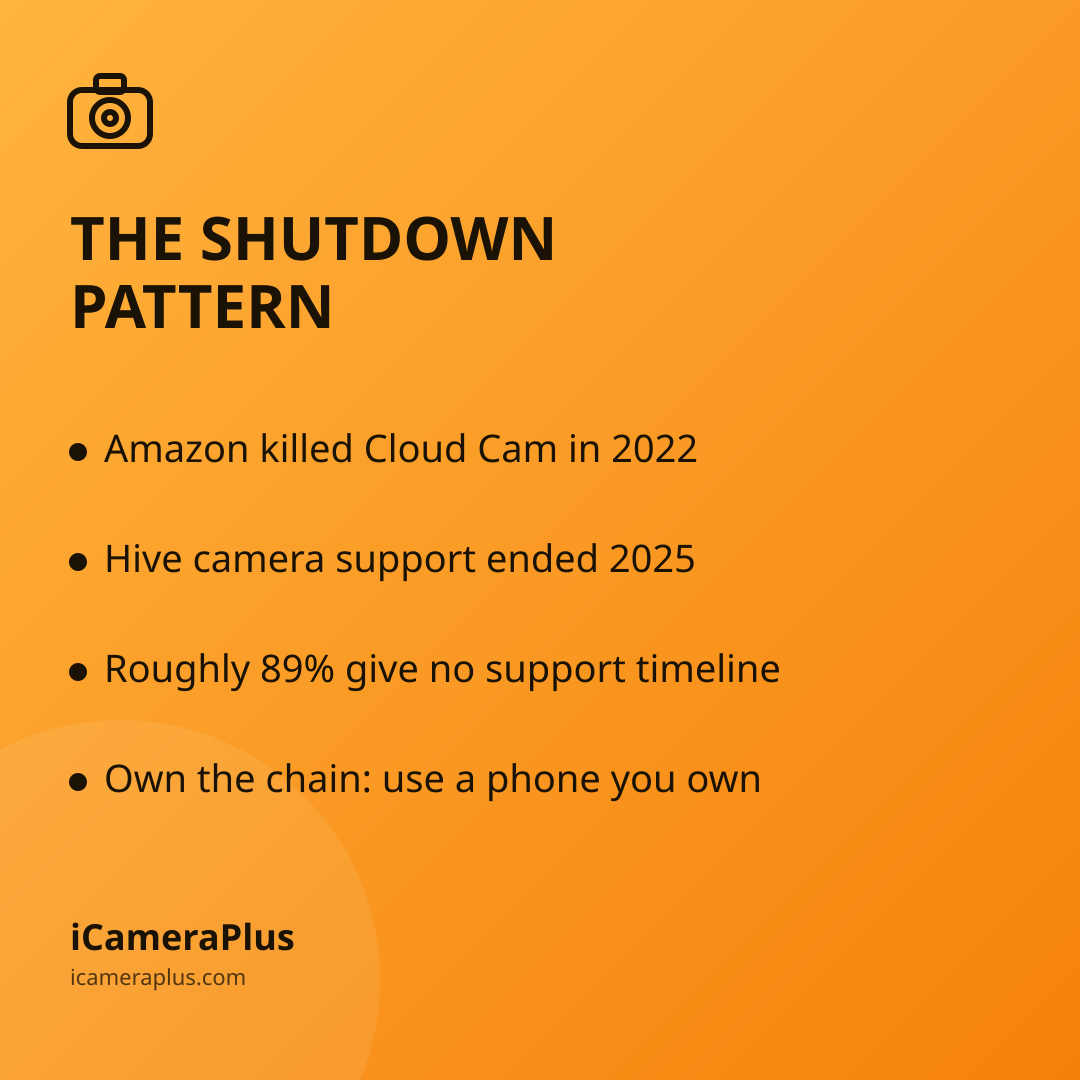
Belkin is just the most recent name on a list that keeps growing. In 2022, Amazon announced it would shut down Cloud Cam, its home security camera, on December 2 of that year — after which, as TechCrunch reported, "all video history will be deleted and the service will no longer function." Amazon offered affected customers a free replacement camera and a year of subscription service, which was a relatively generous exit compared to most.
Hive took a similar path with its home security line. As The Register reported in 2022, the company announced that indoor and outdoor camera support, along with its HomeShield service, would end on August 1, 2025 — and it did, leaving those cameras unable to function. Hive said the decision let it refocus on other product areas.
Pattern spotted: a company built a device around its own cloud, sold it as a security product, and then — for entirely legal, often reasonable business reasons — decided to stop paying to keep that cloud running. The device didn't break. The company just stopped supporting it.
Regulators Have Noticed, Too
This isn't just a string of anecdotes. In November 2024, the Federal Trade Commission published a staff report examining software support disclosures across 184 connected devices, including smart home products. The findings were stark: roughly 89% of manufacturer product pages gave no information at all about how long a device would keep receiving software support, and only about 11% disclosed an end date up front. The FTC staff report warned that failing to disclose this information could, in some cases, amount to a deceptive practice under the FTC Act.
In plain terms: when you buy a connected security camera, you are very likely buying a product whose expiration date the manufacturer has not told you — and may not have decided yet.
Why This Matters More for Security Cameras Than Anything Else
A smart plug that stops working is an inconvenience. A security camera that stops working is a gap in your protection — and, if it happens without warning, it can mean losing access to footage right when you might need it most: after a break-in, a package theft, or a dispute with a neighbor or contractor. A camera's entire value proposition is "we'll have the recording when you need it." A shutdown notice quietly erases that promise.
There's also a physical cost. Every camera, doorbell, or sensor that goes from "smart" to "e-waste" the day a company flips a switch adds to a problem that's already large. The Global E-waste Monitor 2024, produced by the United Nations Institute for Training and Research (UNITAR) and the International Telecommunication Union, found that the world generated 62 million tonnes of electronic waste in 2022, and only 22.3% of it was documented as properly collected and recycled — with e-waste generation now growing five times faster than recycling rates. A bricked camera doesn't recycle itself; it usually ends up in a drawer, then a landfill.
Questions Worth Asking Before You Buy — or Keep Using — a Camera
- Does the manufacturer publish a software support timeline? Per the FTC's findings above, most don't — so if you can't find one, assume the clock could stop at any time without notice.
- Does the camera work at all without that company's cloud? Local storage, HomeKit compatibility, or an SD card option all give you a fallback.
- Can you export your footage on your own schedule? If the answer is "only through our app, only while it's running," your archive is only as durable as the company is.
- What happens to the hardware if the service ends? A camera that becomes a paperweight is a camera that becomes e-waste.
A Simpler Way to Own the Whole Chain
One way to sidestep this entire problem is to stop buying single-purpose camera hardware tied to one company's continued existence — and use a phone you already own instead. That's the idea behind apps like iCameraPlus: it turns an old phone into a home security camera with continuous recording, remote live view, motion alerts, and an off-device archive you control, without asking you to bet your security on a single manufacturer's business roadmap. The phone itself isn't proprietary security hardware that becomes useless the day a company "refocuses" — it's just a phone doing a job, and if you ever change providers, the device doesn't have to go in a drawer.
It's also one small way to push back on the e-waste numbers above: a phone that would otherwise sit unused, or eventually get tossed, keeps doing something useful instead of adding to the pile.
If a Company You Rely On Announces a Shutdown
- Download or export any stored footage immediately — don't wait until the deadline week.
- Check whether the device supports a local fallback (Apple HomeKit, Thread, or on-device storage) before support fully ends.
- Ask about warranty-based refunds or replacement offers; some companies (like Amazon with Cloud Cam) provide them.
- Before replacing the device, decide whether you want to depend on another single-vendor cloud again, or choose a setup — like a repurposed phone — that isn't tied to one company's fate.
None of this means every connected camera is a bad bet, or that every company will eventually vanish. But the Wemo shutdown, the Cloud Cam shutdown, and the Hive exit all rhyme for a reason: cloud-dependent hardware only lasts as long as its maker wants to keep paying for the cloud. Building your home security around that assumption is worth a second look.
Sources
- 9to5Google: "Belkin reminds users that its Wemo smart home products are shutting down this week" (2026)
- Belkin Official Support: "Wemo Support Ending – What You Need to Know"
- TechCrunch: "Amazon is killing its Alexa-connected Cloud Cam" (2022)
- The Register: "Hive to pull plug on smart cameras, security kit" (2022)
- FTC Staff Report: "Smart Device Makers' Failure to Provide Software Updates May Leave You Smarting" (2024)
- UNITAR / ITU: Global E-waste Monitor 2024