Why Are New Phones So Expensive in 2026? The Memory Chip Crisis, Explained
This article was produced with AI assistance. Sources are listed at the end.
New phone prices are climbing sharply in 2026 because of a global memory-chip shortage, not tariffs or ordinary inflation. Entry-level smartphones have already gotten more than 50% more expensive in a year, according to market research firm CCS Insight, because the same DRAM and NAND flash chips that go into phones are being bought up for AI data centers. The practical upshot for homeowners: more people are holding onto the phone they already own for longer, and some are giving it a second life — including as a security camera — instead of paying up for a new one.
Why are new phone prices rising in 2026?
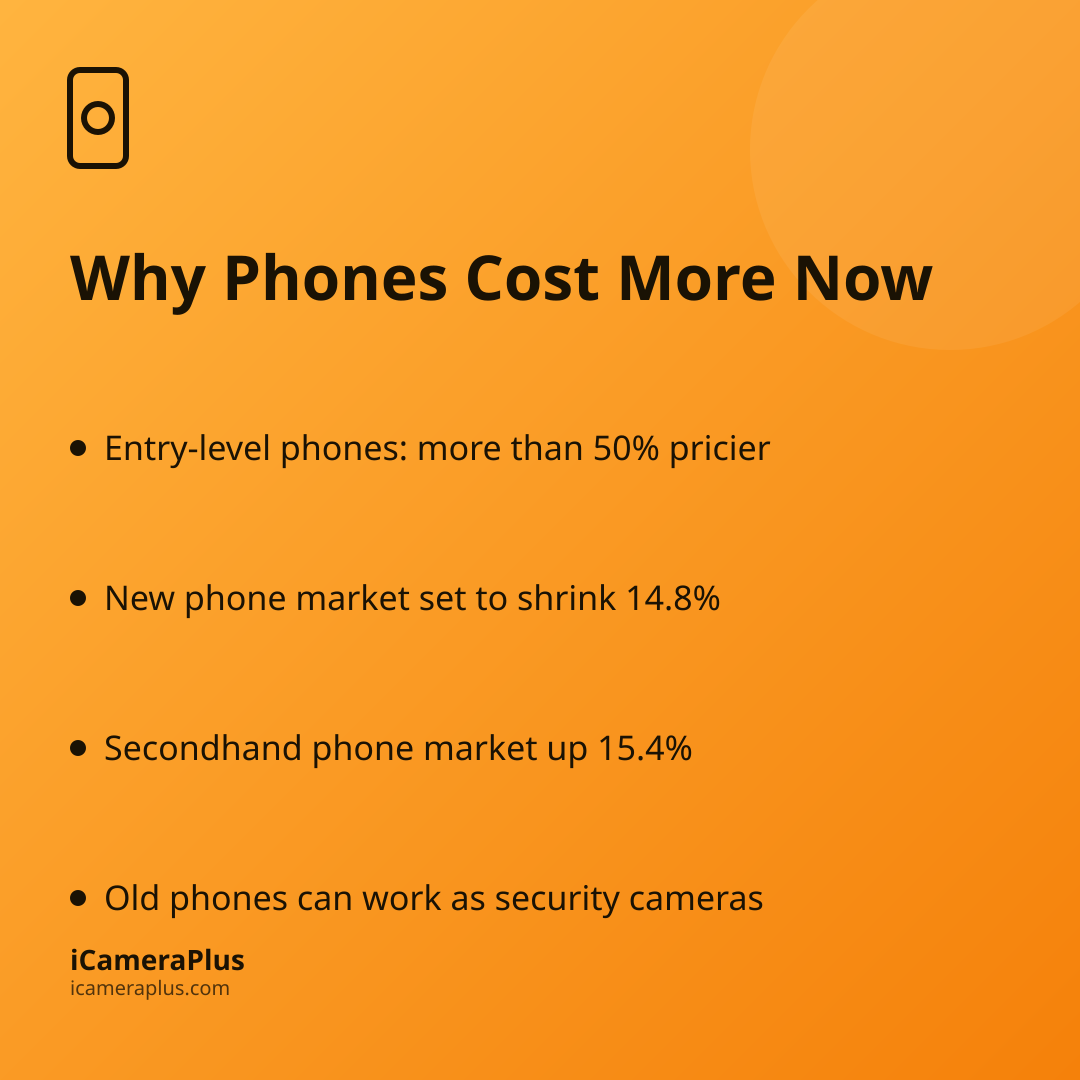
The short answer is memory. Smartphones need DRAM (for active memory) and NAND flash (for storage), and both have gotten dramatically more expensive this year as AI servers compete for the same production capacity. CCS Insight projects that the global primary smartphone market will contract 14.8% for full-year 2026, even as manufacturers raise prices to cover rising component costs — a sign that buyers are pulling back, not that demand for phones has vanished.
"Some entry-level smartphones have already seen prices rise by more than 50% compared with this time last year," said Ben Hatton, a research analyst at CCS Insight, in a June 2026 report.
What's actually driving the chip shortage?
Data centers building out AI infrastructure are absorbing a large share of the world's memory-chip supply, leaving less for consumer electronics. TrendForce, a semiconductor market research firm, reported that mobile DRAM contract prices kept climbing through the second quarter of 2026, with average selling prices for LPDDR4X chips up 70–75% quarter-over-quarter and LPDDR5X up 78–83% — cost increases that phone makers are passing on to buyers rather than absorbing. TrendForce has tracked comparably steep increases in NAND flash contract pricing across the same period — including a projected 70–75% quarter-over-quarter rise for the second quarter of 2026 — driven primarily by AI server demand rather than smartphone demand itself.
That's a structural shift, not a short-term blip: TrendForce's later 2026 outlooks still show memory contract prices rising, just at a slower pace, into the second half of the year.
Is this pushing more people toward used and refurbished phones?
Yes — and the data backs it up in multiple markets. CCS Insight forecasts the global organized secondary smartphone market will grow 15.4% in 2026, even as the new-phone market shrinks. In India, Counterpoint Research found refurbished smartphone volumes rose 13% year-over-year in the first half of 2026, while new smartphone volumes fell roughly 11% over the same period; Counterpoint expects refurbished growth to reach 16% for the full year as rising new-device prices push buyers toward trade-ins and recent-generation used devices.
In other words, a growing share of people are deciding that the phone already in their pocket, or sitting in a drawer, is worth more than the price of a new one.
So what should you actually do with the phone you already have?
If you're not ready to pay inflated 2026 prices for a new phone, the most useful thing you can do with an old one isn't necessarily to sell it. A retired phone already has a camera, a microphone, Wi-Fi, and a battery — everything a basic home security camera needs. Instead of buying a dedicated camera or a new phone, you can put an old device to work watching a door, a driveway, or a nursery in your own home.
- Keep your current phone another cycle
- Give an old phone a second job instead of a landfill trip
- Skip buying a dedicated camera for now
- Wipe the device properly before reuse or resale
Apps like iCameraPlus are built for exactly this: they turn a phone you already own into a 24/7 security camera, with continuous recording to a private cloud archive you can browse from the web, live view from a web panel, remote start and stop, audio and video, and a screen-dimming option so the phone isn't lit up all night. It works on both iOS and Android, so it doesn't matter which old phone is sitting in your drawer.
If you'd rather compare that approach against buying new hardware, see our guide to home security cameras for the broader landscape.
Does the memory chip crisis affect dedicated security cameras too?
It's a related but separate story. Many standalone security cameras also rely on memory chips and have faced their own cost pressure in 2026 — we covered that in detail in Why Are Security Camera Prices Going Up in 2026? It's Not Just Tariffs. The short version: reusing a phone you already own sidesteps that pressure entirely, since you're not buying new hardware at all.
Quick answers
Will phone prices come back down in 2026 or 2027? Not quickly. TrendForce's quarterly outlooks through late 2026 still show memory contract prices climbing, just at a slower pace than the steep jumps seen earlier in the year, so relief is likely to be gradual rather than immediate.
Is it a bad time to buy a new phone just to use as a security camera? Given 2026's price spike, it's an expensive way to solve a problem an old phone can usually handle for free. A retired phone already has the camera, microphone, and Wi-Fi needed for basic home monitoring.
What should I do with a phone I truly don't need anymore? If you've decided a device won't get a second life in your home, see our research on whether selling your old phone actually helps the environment before you trade it in or recycle it.

Sources
- CCS Insight: "Global Smartphone Market to Decline 15% in 2026 amid Memory Chip Crisis" (June 2026)
- TrendForce: "Mobile DRAM Contract Prices Continue Rising in 2Q26, Pressuring Smartphone Production" (May 2026)
- TrendForce: "AI Server Demand to Drive Memory Contract Price Increases in 2Q26 as CSPs Secure Supply via Long-Term Agreements" (March 2026)
- TrendForce: "Server DRAM Contract Prices Expected to Rise 13–18% QoQ in 3Q26" (July 2026)
- Counterpoint Research: "India Refurbished Smartphone Volumes Grew 13% YoY in H1 2026" (2026)