Wildfire Season 2026 Is Already Ahead of Schedule — Why Your Camera's Footage Shouldn't Live Only on the Camera
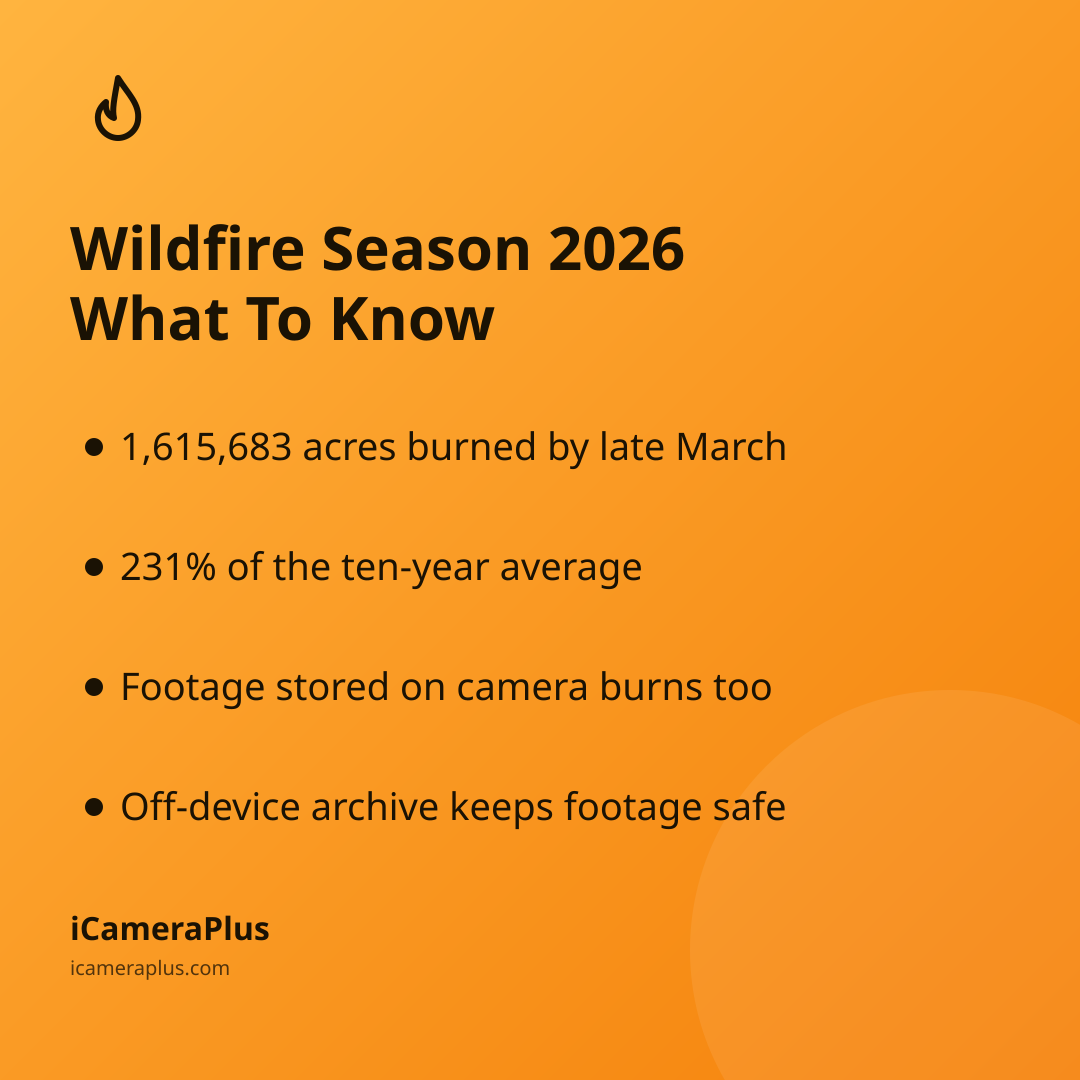
By late March 2026, wildfires had already burned 1,615,683 acres nationwide — 231% of the ten-year average for that point in the season, according to National Interagency Fire Center (NIFC) data. The agency raised the National Preparedness Level to 2 on March 20, 2026, months earlier than usual, citing an "unprecedented early season heat wave" that dried out fuels ahead of schedule. Heading into late summer, NIFC's outlook flags below-average precipitation across the Great Basin, the Southwest, California, and the southern High Plains — the ingredients for a long, active season.
If you live anywhere near wildland, that's the backdrop for this article. Two things are worth thinking through before smoke shows up on the horizon: what a home camera can actually do for you during a wildfire, and a storage mistake that quietly undoes the whole point of having one.
What a Camera Can — and Can't — Do During a Wildfire
A camera pointed at your property can't stop a fire and shouldn't be the reason anyone delays evacuating. But remote live view has genuinely changed what it's like to wait out a fire from a safe distance. In a widely reported case from the 2016 Fort McMurray wildfire in Alberta, homeowner James O'Reilly and his wife watched their house burn in real time through a smart home camera app on their phone while they were already safely evacuated, an account later covered by Digital Trends. More recently, doorbell and security camera footage from residents fleeing the 2026 Sandy Fire near Simi Valley, California, and from a July 2026 wildfire in the Community of Madrid, Spain — which forced roughly 30,000 people from their homes across the region, according to Spain's Ministry of the Interior as reported by CNN (2026) — has been used to document how fast conditions changed and to warn neighbors in real time.
The practical value isn't closure — it's information. Checking a live feed from a hotel room or a relative's house tells you whether it's safe to attempt a return, whether embers have reached your yard, or whether an evacuation order is about to become urgent. That's a decision-support tool, not a replacement for official alerts from your county or state fire agency.
The Weak Link Most People Don't Think About
Here's the part that catches people off guard: most home cameras store their footage in the same place they're mounted — on a microSD card inside the camera, or on a base station plugged in nearby. If the structure burns, that storage burns with it. The footage that could have documented exactly what your home looked like a day, a week, or a month before the fire — furniture, electronics, the condition of a room — is gone along with everything else.
This is really a continuity problem, not just a fire problem: the same failure happens if a camera is stolen, damaged by a power surge, or simply stops working. Any camera setup is only as good as where its recordings actually live. This is one reason iCameraPlus, which turns a phone you already own into a continuous-recording home camera, keeps an off-device archive of what it records — so the footage still exists even if the phone itself doesn't survive whatever it was recording. If you're setting up any camera ahead of fire season, it's worth checking, specifically, where your own footage is stored and whether it would survive the same event your home might not.
Defensible Space Still Does the Heavy Lifting
Cameras and documentation are secondary to the thing that actually determines whether a home survives a wildfire: defensible space. The National Association of Insurance Commissioners (NAIC) recommends clearing combustible materials within five feet of your home's structure, using hard, non-combustible surfaces like concrete or rock mulch close to the house, keeping vegetation watered and free of dead growth, and never storing wood or furniture under a deck. Cal Fire's Ready for Wildfire program describes defensible space as a buffer — extending up to 100 feet from the home in high-risk zones, as required by law under Public Resources Code 4291 — that gives firefighters a fighting chance and reduces the odds embers can catch on something flammable near your walls.
None of that requires a camera. But it's the context a camera sits inside: a well-hardened home with a documented, remotely viewable record is in a meaningfully better position than one with neither.
If the Worst Happens: Documenting Your Home for a Claim
Standard homeowners' insurance policies cover wildfire damage, and California requires insurers to advance at least one-third of a policyholder's estimated personal property value and four months of rent for displaced households, according to reporting on state requirements by CBS News. But the size and speed of a settlement still depends heavily on documentation. Insurance regulators and industry guides consistently point to the same weak spot: claims with thin or missing proof of what a household owned take longer to settle and are more likely to be underpaid.
The NAIC offers a free home inventory tool for exactly this reason, and California's Department of Insurance publishes a Home Inventory Guide encouraging residents to photograph or video every room, including closets, garages, and storage areas, well before any loss occurs. A camera that's already recording your home day to day is, in effect, a rolling version of that same inventory — provided its footage is archived somewhere that isn't the device sitting in the fire's path.
A Practical Checklist Before Fire Season Peaks
- Confirm where your camera footage actually lives. If it's only on the device or a local SD card, it offers no protection against the exact scenario — fire, theft, device failure — that makes footage most valuable.
- Put an old phone to work. If you have a retired phone in a drawer, it can run as a dedicated home security camera with continuous recording and an off-device archive, at no added hardware cost.
- Do a slow video walkthrough now. Open closets and cabinets, narrate what you're seeing, and store the video somewhere other than your home network.
- Check your defensible space zones against Cal Fire's or your state fire agency's current guidance, especially the five-foot zone immediately around your home's foundation.
- Know your evacuation triggers in advance — set them by official alerts, not by what you can see on a camera feed, and never delay leaving to check a live view first.
Wildfire risk is largely outside anyone's control once conditions turn. What is controllable is whether the evidence of what you owned, and the ability to check on your home from somewhere safe, survives the event too.
Sources
- International Code Council, "2026's Fire Season Is a Warning Light" (2026), citing NIFC data
- National Interagency Fire Center, National Significant Wildland Fire Potential Outlooks (2026)
- Digital Trends, "Homeowner Watches Home Burn Via Smart Home Camera"
- ABC7 Los Angeles, Sandy Fire coverage, Simi Valley (2026)
- CNN, "France and Spain wildfires" live coverage, citing Spain's Ministry of the Interior (July 26, 2026)
- National Association of Insurance Commissioners, "Protecting Your Home From Wildfires"
- Cal Fire, Ready for Wildfire — Defensible Space
- CBS News, "What California homeowners should know about filing an insurance claim for fire damage"
- California Department of Insurance, Home Inventory Guide