Clocks Fall Back November 1, 2026 — Does That Really Mean More Break-Ins?
This article was produced with AI assistance. Sources are listed at the end.
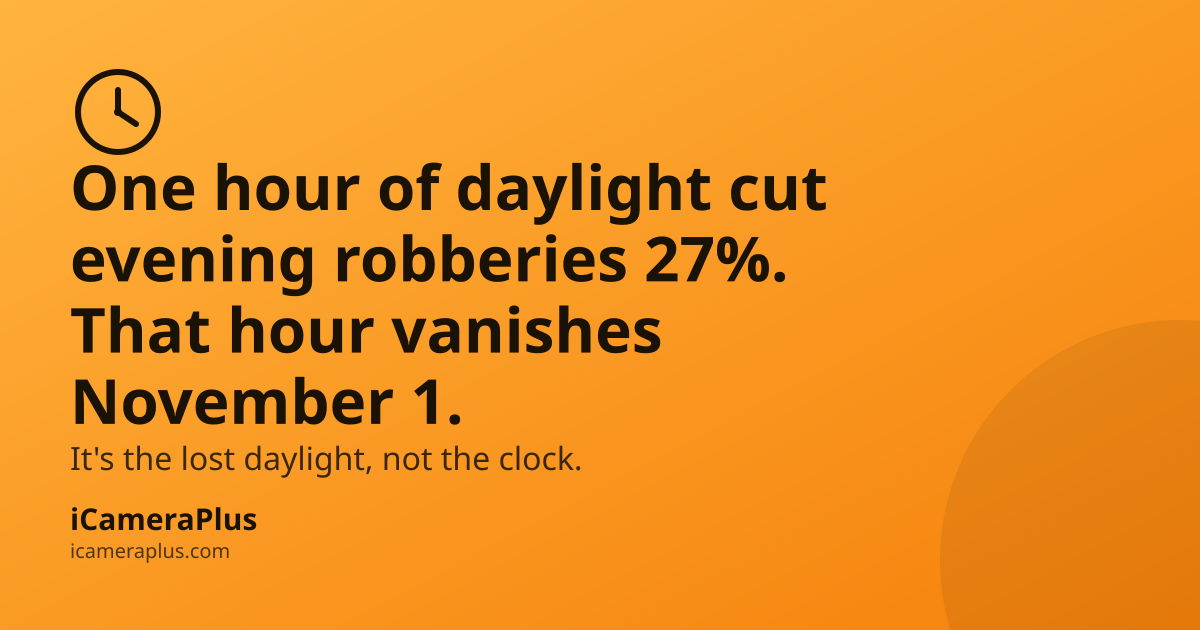
Yes, but with an important nuance. Clocks fall back on Sunday, November 1, 2026, pushing sunset an hour earlier by the calendar, and the most-cited research on this exact transition found that evening robbery rates rise when that hour of darkness returns after the sun sets. The effect is real and measured — but it's about ambient light during commute hours, not the clock change itself acting as some kind of curse.
Here's what the data actually shows, why this particular "fall back" is getting extra attention in 2026, and what's worth doing at your own front door before sunset starts arriving an hour earlier.
What Does the Research Actually Say About Darkness and Crime?
The most cited study on this comes from economists Jennifer Doleac and Nicholas Sanders, published in the Review of Economics and Statistics and summarized by the Brookings Institution in 2015. The researchers analyzed national incident data covering 558 jurisdictions and roughly 22 to 24 million people between 2005 and 2008, using Congress's 2007 extension of daylight saving time as a natural experiment.
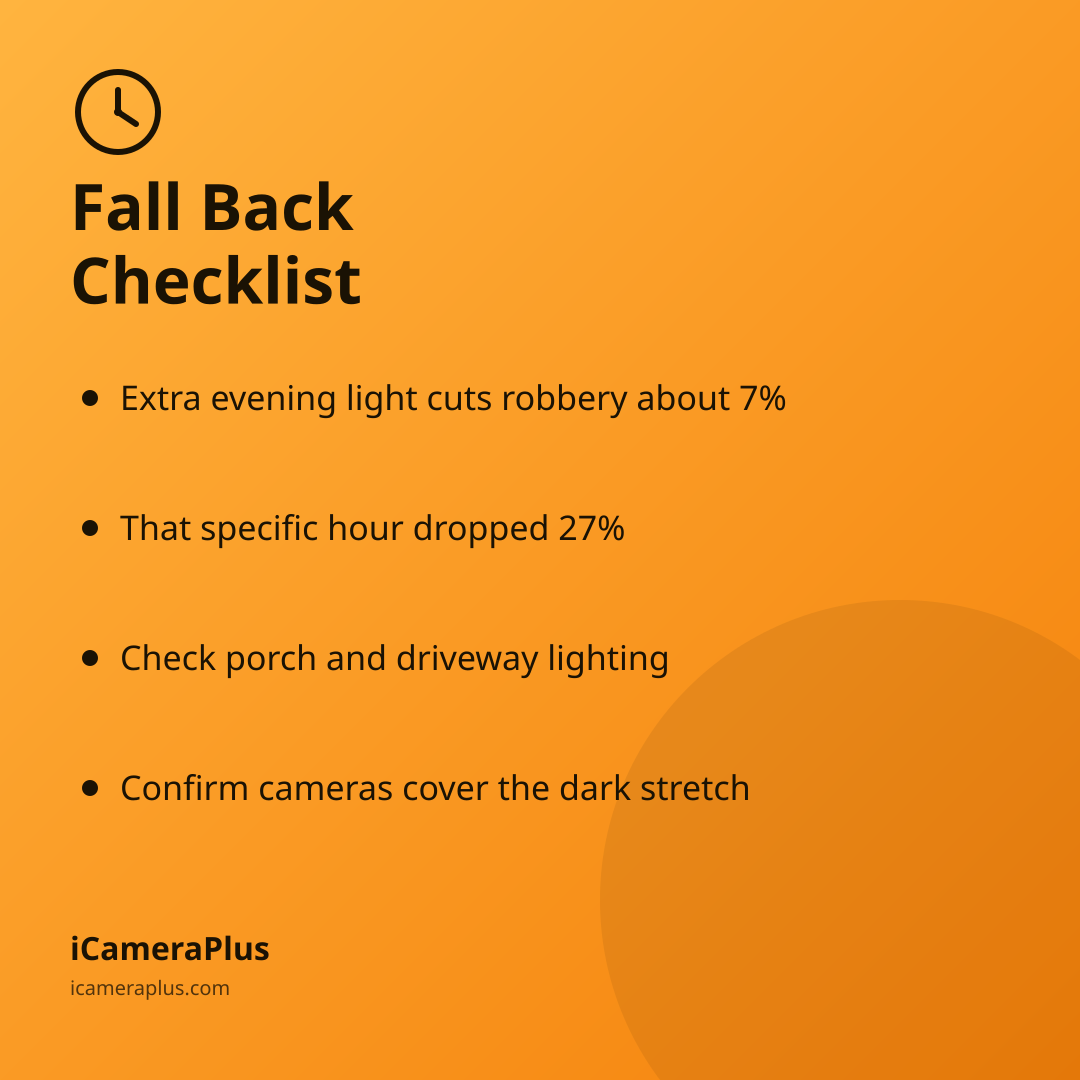
They found that when clocks spring forward and evenings gain an hour of daylight, overall daily robbery rates fall by about 7 percent — and by 27 percent during the specific evening hour that gained the extra light, according to Cornell University's summary of the paper. Logically, the reverse holds too: when the November clock change removes that hour of evening light, the same window becomes measurably riskier. The researchers estimated the 2007 spring extension alone avoided roughly $59 million in social costs from reduced evening robberies.
The headline number: robbery rates fell 27 percent in the specific hour that gained daylight.
It's worth being precise about what was actually measured: this is a study of street robbery tied to ambient light during the evening commute, not a general finding that home burglaries spike the week clocks change. But the mechanism — less daylight exactly when people are arriving home from work or school — is the same window safety researchers point to for a range of home-adjacent, opportunistic crime.
Why Is 2026's Clock Change Getting Extra Attention?
This year's "fall back" carries extra weight because Congress is actively debating whether to end it. The Sunshine Protection Act, which would make daylight saving time permanent nationwide, passed the U.S. House on July 14, 2026, by a vote of 308 to 117. The bill is still waiting on the Senate, where a similar measure previously stalled amid concerns about parts of the country not seeing sunrise until after 9 a.m. in winter under a permanent shift.
So for now, the clocks still move back on November 1, 2026, per AccuWeather's 2026 daylight saving time schedule. Whether this is one of the last times the U.S. makes this particular change is genuinely undecided in Washington right now.
What Should You Actually Do Before the Clocks Change?
None of this calls for panic. It calls for a five-minute walk around your property with the new sunset time in mind, ideally before the weekend the clocks actually move.
- Walk entry points at the new "dark o'clock"
- Check porch and driveway lighting works
- Confirm cameras actually cover the dark stretch
- Test batteries and app notifications
The biggest blind spot for most households isn't the camera pointed at the street, it's the side door, the garage entry, or the stretch of walkway that used to get evening light and suddenly doesn't. That's also a spot where a device you already own can help without buying anything new. A spare phone propped on a shelf or simple mount, left running continuously, gives you a plain record of that newly dark hour. Apps like iCameraPlus turn a spare iOS or Android phone into a 24/7 camera with continuous recording, audio and video, and a private cloud archive you can browse and live-view from a web panel — so if anything happens during that stretch after sunset, the footage already exists instead of you wishing you'd set something up.
For more on placement and seasonal reliability, our guide to home security camera basics and our look at what cold weather does to camera batteries both cover the entry-point and reliability side of this same seasonal shift.
Quick answers
Does this research mean home burglaries specifically go up when clocks change?
Not exactly. The Doleac and Sanders research measured street robbery tied to evening ambient light, not home burglary rates directly. But the same mechanism — less daylight during the hours people are commuting home or answering the door — is why safety researchers flag early sunset as a higher-risk window for entryways generally.
Will the U.S. stop changing the clocks after this year?
Not yet. The Sunshine Protection Act passed the House in July 2026, but as of this writing it hasn't passed the Senate or been signed into law, so the November 1, 2026 change is still happening as scheduled.
Does earlier darkness affect trick-or-treating too?
Yes, and it lands right before the clock change. Halloween falls on October 31, one day before clocks move back on November 1, so families dealing with early dusk on Halloween night get almost no adjustment period before evenings get even darker; our Halloween safety data breakdown covers that specific evening in more detail.
Sources
- Brookings Institution — Fighting Crime With Daylight Saving Time (2015)
- Cornell Chronicle — Fall back and watch out: Robbers thrive on standard time (2015)
- Doleac & Sanders — Under the Cover of Darkness (working paper PDF)
- Congress.gov — H.R. 139, Sunshine Protection Act of 2025
- NBC News — House passes bill to make daylight saving time permanent (2026)
- AccuWeather — Daylight Saving Time 2026: When Do Clocks Fall Back? (2026)