Do Security Cameras Keep Recording During a Power Outage? 2026 Data
This article was produced with AI assistance. Sources are listed at the end.
Most plug-in and hardwired security cameras stop recording the instant the power goes out, because they draw electricity continuously from a wall outlet or a networked switch. In 2024, the average U.S. electricity customer lost power for about 11 hours — the highest annual total in at least a decade, according to the U.S. Energy Information Administration (EIA), 2025. If your camera has no battery of its own, that's 11 hours of your home going unwatched.
Does a security camera actually stop recording when the power goes out?
For most wired and plug-in cameras, yes. They have no internal power source, so when the breaker trips or the grid goes down, they go dark immediately — no warning, no buffer. Even battery-backed security hubs aren't a full fix: Ring's own support documentation for its Alarm Pro base station notes that during an outage the device "turns off most functions and wifi to save energy," leaving only alarm arming and emergency dispatch active while the battery runs down, according to Ring's official support page. In other words, the parts of a system people actually rely on — live camera feeds and continuous recording — are often the first things to go.
How often do power outages actually happen in 2026?
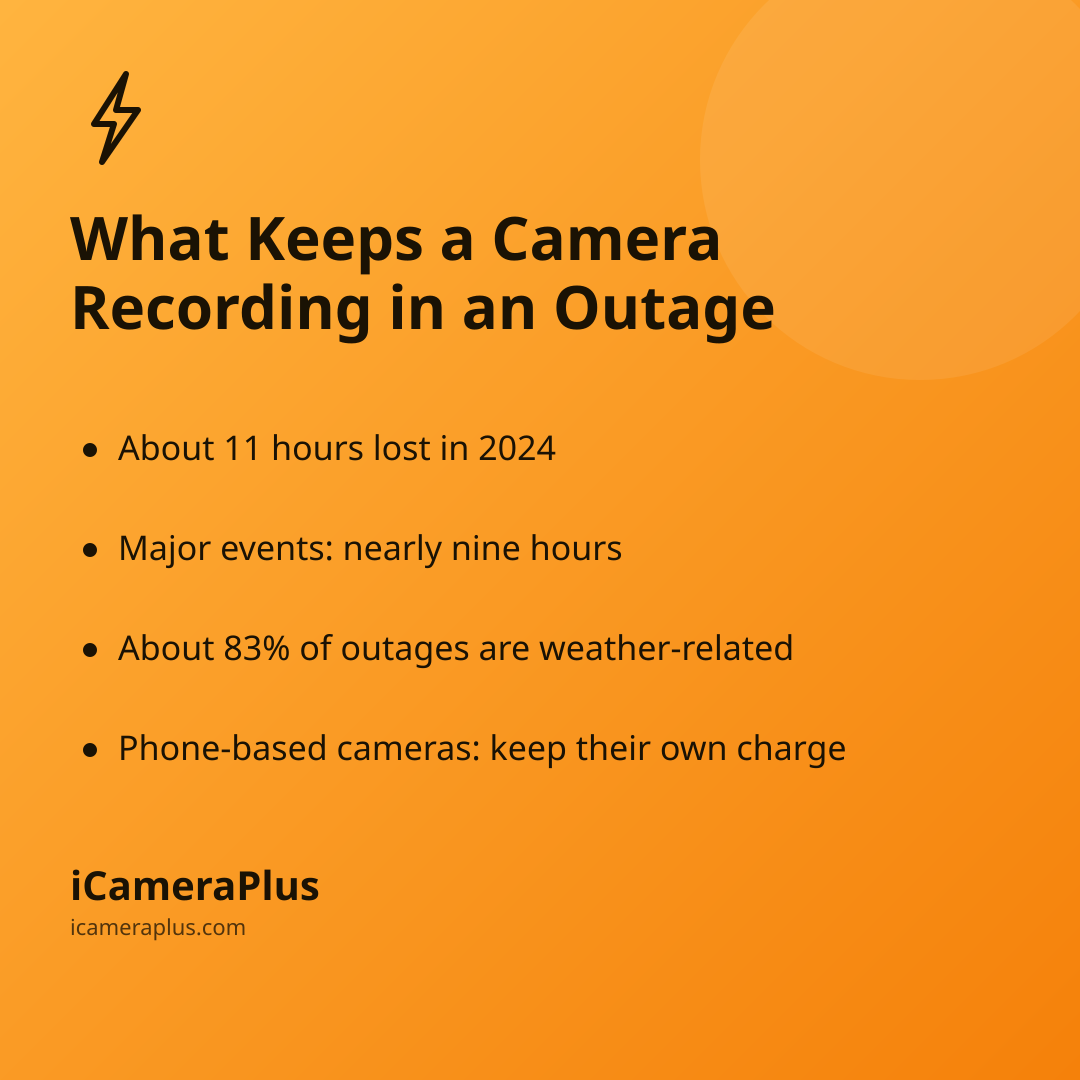
More often, and for longer, than they used to. The EIA reports that interruptions tied to major events — hurricanes, ice storms, wildfires — averaged nearly nine hours per customer in 2024, compared with about four hours a year from 2014 through 2023, according to the EIA, 2025. The same analysis found that Hurricanes Beryl, Helene, and Milton alone accounted for 80% of all the hours Americans spent without power that year. Even outages unrelated to a major storm still average roughly two hours a year nationwide, per the EIA — so even a "normal" year isn't a guarantee your camera stays on.
Why are outages becoming more common?
Weather is the main driver. About 83% of major U.S. power outages between 2000 and 2021 were weather-related, and weather-triggered blackouts were roughly 64% more frequent in the 2011–2021 period than in 2000–2010, according to Climate Central's 2022 analysis of federal outage data. Severe storms, aging grid infrastructure, and heavier seasonal demand are pushing more homes into the dark more often — which is exactly when a camera matters most.
What actually keeps a camera recording through an outage?
An outage doesn't have to mean a blackout in your footage — but it depends entirely on what's powering the camera. A standalone uninterruptible power supply (UPS) can keep a wired camera system running for a limited window, though runtime drops fast as more devices share the load. Some newer cameras ship with their own backup battery, typically good for a few hours. And a camera that already runs on its own battery — like a phone — doesn't need a separate backup device at all, because the battery is already built in.
This is one of the practical advantages of turning a spare phone into a security camera with an app like iCameraPlus: since the phone has its own battery, it can keep capturing continuous video even if the wall power or Wi-Fi briefly drops, and once your connection is back, footage syncs to your private cloud archive, which you can browse from the web. It's not a substitute for whole-home backup power, but it means a short outage doesn't automatically create a gap in your coverage.
- Plug-in cameras: usually no battery, stop instantly
- Battery-backed hubs: often cut non-essential functions first
- Phone-based cameras: keep their own charge
- Cloud archives: sync resumes once power returns
What should you do before the next outage?
Start with the basics recommended by the Federal Emergency Management Agency (FEMA):
- Flashlights in every room
- Charged power banks on hand
- A plan to keep phones charged
- Generators outdoors only, never near windows
If you're heading into storm or winter season and closing up a property you won't be checking daily, it's worth pairing outage planning with a broader seasonal checklist — see our guide on securing a vacation home before winter. And if you're still deciding how much camera coverage your home actually needs in the first place, our breakdown of how many cameras a home actually needs is a good starting point. For a phone set up as a camera, keep it charging on a cord rated for continuous use, and consider a small battery pack as a secondary buffer in outage-prone areas.
Quick answers
Will my doorbell camera work if the power goes out? Only if it runs on its own battery. Hardwired doorbells typically lose power with the rest of the house, while battery-powered doorbells keep working until that battery runs down.
Does a UPS keep a security system running for a full outage? Not usually for a long one. A typical small UPS keeps a camera system running for well under an hour once a router, DVR, or multiple cameras are sharing the load — enough to ride out a brief blip, but not a multi-hour event.
Does Wi-Fi going down also stop my camera? It stops live viewing and cloud uploads, but a camera that records locally — including a phone running a recording app — can keep capturing footage on its own storage until the connection returns.
Sources
- U.S. Energy Information Administration — "Hurricanes in 2024 led to the most hours without power in the United States in 10 years" (2025)
- Climate Central — "Surging Weather-Related Power Outages" (2022)
- Ring Support — "Using Ring Alarm Pro During Power and Internet Outages"
- FEMA / Ready.gov — "Power Outages"