Which Smart Home Device Is Most Likely to Get Hacked in 2026? It's Not Your Camera
This article was produced with AI assistance. Sources are listed at the end.
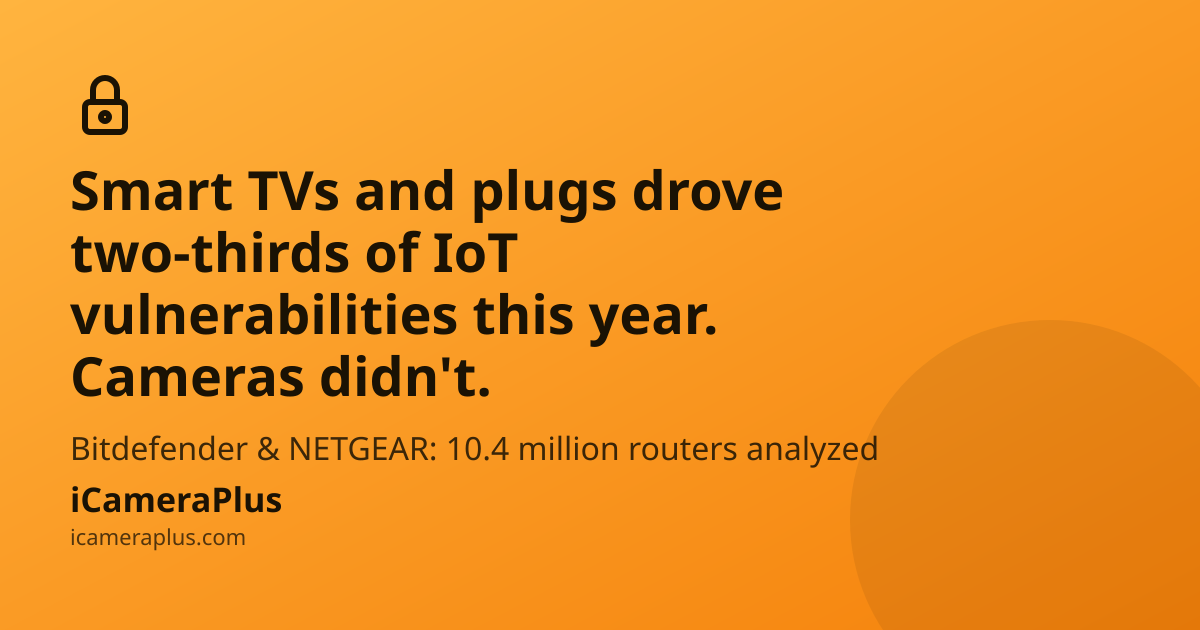
The device most likely to expose your home network to hackers in 2026 probably isn't your security camera — it's your smart TV, your smart plug, or the network storage box in your closet. A joint report from Bitdefender and NETGEAR found that those three categories accounted for roughly two-thirds of all vulnerability observations across 10.4 million protected home routers between January and September 2026.
That doesn't mean cameras are risk-free. It means the "weakest link" in most smart homes isn't the device people worry about most — it's the one they never think about at all.
What did the 2026 IoT Security Landscape Report actually find?
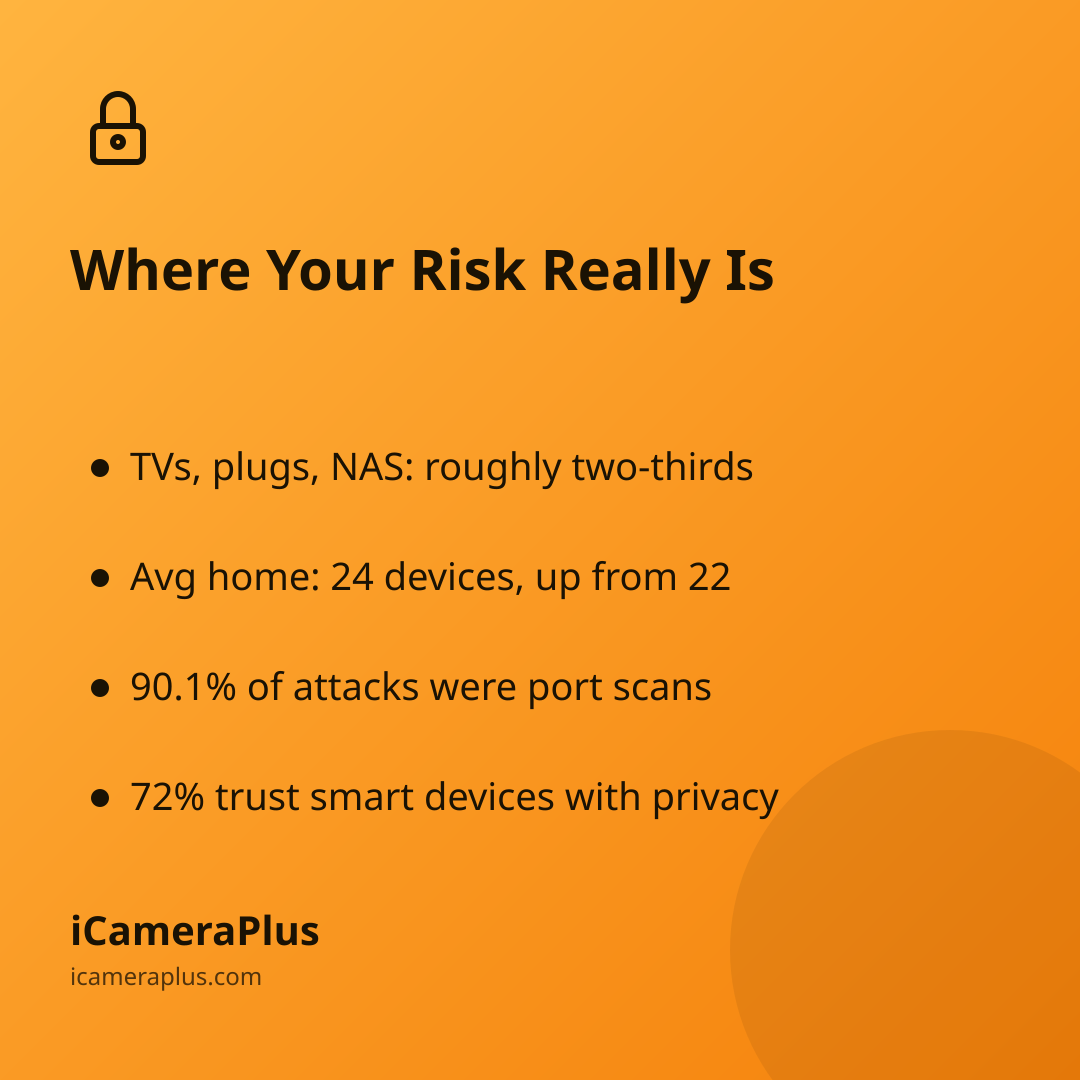
Bitdefender and NETGEAR's 2026 IoT Security Landscape Report analyzed security telemetry from roughly 10.4 million protected home routers, logging 5.4 billion security events and about 1.2 billion vulnerability observations between January and September 2026. Within that vulnerability data, smart TVs (270.3 million observations), smart plugs (266.7 million), and network-attached storage devices (261.6 million) together made up close to two-thirds of everything flagged. The same report found the average household now runs 24 connected devices, up from 22 the year before — more entry points, not fewer.
Your smart TV carries more flagged vulnerabilities than your security camera.
The report also found that 90.1% of roughly 5.38 billion attack-category events were simple port scans — automated probing, not confirmed break-ins — while password brute-force attempts accounted for another 466.6 million events. The researchers noted a single vulnerable device can be exploited four different ways: attacked directly, used as a proxy to relay traffic, used as a sensor to gather information, or used as a foothold into the rest of the home network.
Why are TVs, plugs, and storage boxes the weak point, not cameras?
Dedicated security cameras tend to get more scrutiny from manufacturers and reviewers because "camera gets hacked" is a scary headline. Smart TVs, plugs, and storage devices get far less attention, run older software for longer, and are rarely patched by owners who don't even think of them as "connected devices" that need maintenance. That combination — low visibility, infrequent updates, always-on network access — is exactly what the report's device breakdown reflects.
This echoes a related pattern covered in our look at how outdated camera software can expose a home network: the risk usually isn't the category of device, it's whether anyone is still updating it.
Do homeowners actually trust these devices?
Mostly, yes — which is part of the tension. Vivint's second annual How We Home Report, an OnePoll survey of 5,000 U.S. homeowners conducted in September 2026, found that 78% of homeowners own at least one smart home device and 61% bought a new one in the past year. Despite the ongoing drumbeat of IoT security warnings, 72% of homeowners said they trust their smart devices with their privacy.
Security is also a real driver of that spending: 30% of Vivint's respondents said they'd buy smart devices specifically to protect their home while traveling, and about one in five named "remote monitoring while traveling" as a top reason to invest in smart home security at all.
Does adding more smart devices make your home safer or riskier?
Both, depending on the device. A dedicated security camera that's actually monitored and kept updated adds real value. A smart plug you bought on impulse two years ago and forgot about mostly just adds another unpatched entry point — one more device in that climbing 24-per-household average Bitdefender and NETGEAR measured.
This is one reason some households skip buying a brand-new camera gadget altogether and instead put a phone they already own to work. An app like iCameraPlus turns an old iOS or Android phone into a continuously recording security camera, with footage kept in a private cloud archive you browse from the web and live view and remote start/stop from a web panel — without adding a new, unfamiliar device type to your home network's attack surface in the first place.
- Update every device's firmware, not just cameras
- Put IoT gadgets on their own Wi-Fi network
- Retire devices that no longer get updates
- Skip gadgets you won't actually maintain
What can you actually do about it this week?
None of this requires replacing your whole network. Start with an inventory: list every connected device in the house, including the ones you forgot were "smart" — the TV, the plugs, the robot vacuum, the NAS box. Check whether each one still gets manufacturer updates, and if it doesn't, either isolate it on its own network segment or replace it. If your router supports a guest or IoT network, use it to keep smart-home gadgets off the same network as your laptop and phone. For more on separating what a camera should and shouldn't be trusted with, see our guide on choosing and placing a home security camera.
Quick answers
Does this mean security cameras are completely safe from hackers? No. Cameras have their own history of known vulnerabilities, and basic hygiene — strong unique passwords, prompt firmware updates, and reputable software — still matters. This report simply found that, in 2026, TVs, plugs, and storage devices generated more vulnerability observations than cameras did.
Should I put my security camera on its own Wi-Fi network? It's a reasonable precaution for any always-on connected device, camera included. Most modern routers support a separate guest or IoT network for exactly this purpose.
Does using an old phone as a camera instead of buying a new IoT device reduce this risk? It avoids adding an unfamiliar new device category to your network, since you're using hardware and an operating system you already manage and update. It's not a substitute for basic network hygiene, but it is one less unknown gadget to keep track of — which, as this report shows, is exactly where smart-home risk tends to pile up. If you're weighing whether the phone sitting in your drawer is worth pressing into service, here's what to consider before you decide.