Does Home Insurance Still Cover You If You're a Snowbird This Winter? (2026)
This article was produced with AI assistance. Sources are listed at the end.
Yes — but only for a limited window. Most standard homeowners insurance policies include a vacancy clause that reduces or cancels coverage once a home sits empty for roughly 30 to 60 consecutive days, according to the Insurance Information Institute (Triple-I), 2025. That matters because a winter survey by vacation-rental platform Vacasa found that 34% of Americans were considering or planning to "snowbird" — leave home for an extended stretch in a warmer climate — in a recent season, many for well longer than a month.
If you're closing up the house and heading south this winter, the question isn't just whether you locked the door. It's whether your insurer still considers your home "occupied" enough to pay a claim.
What's the Difference Between "Vacant" and "Unoccupied"?
Insurers typically draw a practical distinction between the two, and it can change what your policy actually pays for. A home is generally treated as unoccupied if it still has furniture, working utilities, and basic household items — just no one currently living there. It's treated as vacant once it's essentially empty: no furniture, no utilities running, nothing personal left behind. Most snowbird homes fall into the "unoccupied" category, which keeps more of a standard policy intact than a fully vacant property would. Exact definitions vary by carrier, so confirm the wording in your own policy rather than assuming either label applies.
How Long Can You Be Away Before Coverage Changes?
This is the number that catches people off guard. The Insurance Information Institute reports that most homeowners policies limit or exclude coverage — including theft and water damage — once a property has sat unoccupied for 30 to 60 consecutive days. "Vacant homes often carry more risk than meets the eye," Triple-I notes in its 2025 guidance on vacancy insurance, pointing to burst pipes, theft, and liability exposure as the main culprits (Insurance Information Institute, 2025).
A typical snowbird trip — a month to several months in Florida, Arizona, or Texas — often runs right up against or past that threshold. If you don't check in with your insurer first, you may not find out your coverage lapsed until you're filing a claim, not before.
What Do Insurers Actually Require While You're Away?
Requirements vary by carrier, but a few show up consistently in Triple-I's guidance and across insurer policy language:
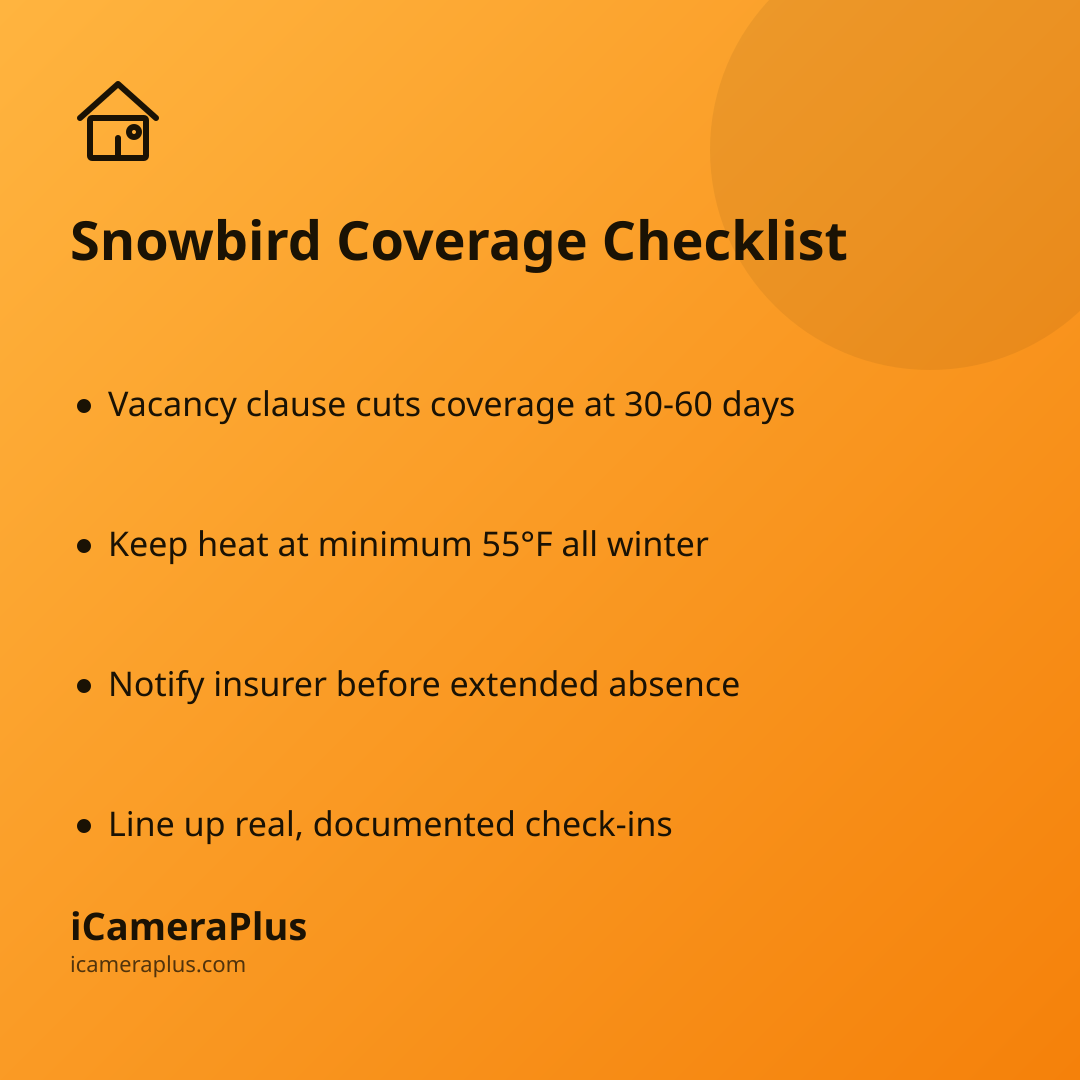
- Notify your insurer before an extended absence
- Keep indoor heat at a minimum of 55°F through winter
- Arrange for someone to check on the property periodically
- Ask about a vacancy endorsement or a separate vacant-home policy if you'll exceed the 30- to 60-day window
The heat requirement is specific and non-negotiable in most policies: the Insurance Information Institute notes that a burst pipe from an unheated home can run $10,000 to $70,000 or more in repairs, and failing to maintain that minimum temperature can void coverage even under a vacant-home policy (Insurance Information Institute, 2025).
After 30 days empty, a home can start losing insurance coverage, not gaining peace and quiet.
How Can You Prove Someone Is Actually Checking on the House?
"Arrange for check-ins" is easy advice to give and hard to document after the fact. A neighbor's spot-check or a paid home-watch visit works, but if a pipe bursts in week six of a three-month trip, you'll want more than a verbal assurance that someone looked in on the place.
This is where a camera you already own can do double duty. If you have an old smartphone sitting in a drawer — and a lot of households do — an app like iCameraPlus can turn it into a camera that records continuously, archives footage to a private cloud you can browse from any browser, and lets you check the live view or start and stop recording remotely, all without you being in the house. It won't tell your insurer anything on its own, but it gives you — and whoever you've asked to check in — an actual record that the house was fine on a given day, not just a guess.
That matters even more at night, when a home is otherwise unmonitored for the longest stretch; see how an old phone performs as an overnight security camera if that's a concern for the empty hours. It's also a lower-cost starting point than a professional home-watch contract if you're testing out a first snowbird winter before committing to one.
Quick Pre-Departure Checklist
- Call your insurer first
- Ask about a vacancy endorsement
- Set heat to 55°F minimum
- Line up real, documented check-ins
Quick Answers
Does a security camera satisfy an insurer's "check-in" requirement?
Not by itself — insurers generally want a person physically checking the property, not just a live feed. A camera is best used alongside a check-in arrangement, as a way to confirm conditions between visits or verify nothing changed on the days no one went by.
What happens if I don't tell my insurer I'll be gone for months?
You risk a denied claim. If your home crosses the 30- to 60-day vacancy threshold and something happens — a burst pipe, a break-in — your insurer can point to the unreported vacancy as grounds to limit or refuse payment (Insurance Information Institute, 2025).
Is a vacant-home policy expensive?
It typically costs more than a standard homeowners policy and usually excludes personal property and liability coverage that your regular policy includes. The exact premium depends on your carrier and location, so ask your own insurer for a quote rather than relying on a national average.